
Choosing between quartz vs granite countertops is one of the most common decisions homeowners face during a kitchen or bathroom renovation. Both materials offer strong durability, attractive design options, and long-term value, but they differ significantly in maintenance, appearance, cost, heat resistance, and performance.
Many homeowners initially focus on color or price, only to discover later that cleaning requirements, sealing needs, stain resistance, and fabrication details can have a greater impact on everyday satisfaction. Understanding these differences before making a purchase helps prevent unexpected maintenance and ensures the countertop matches how the space is actually used.
The right countertop should complement your home’s design while providing reliable performance for years. Household size, cooking habits, moisture exposure, cleaning routines, and long-term maintenance expectations all influence whether quartz or granite is the better investment.
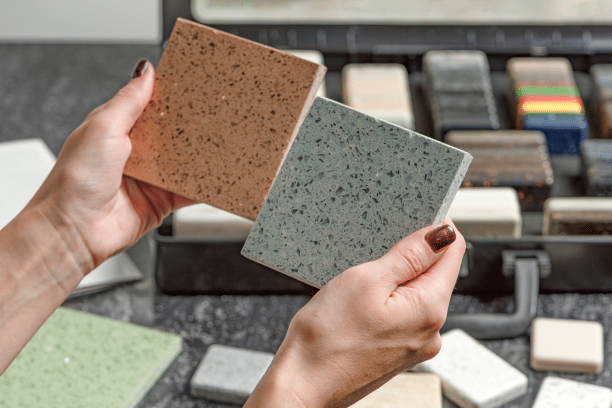
This guide compares both materials in detail, explains how each performs in real-life situations, and provides practical information to help you confidently choose the best countertop for your renovation project.
What Are Quartz vs Granite Countertops?
Quartz vs granite countertops refers to the comparison between two of the most popular countertop materials used in kitchens, bathrooms, laundry rooms, and commercial interiors. Quartz is an engineered stone made from natural quartz minerals combined with resins and pigments, while granite is a natural stone quarried directly from the earth. Both materials provide excellent durability, but they differ in maintenance, appearance, water resistance, heat tolerance, customization, and total ownership cost.
Understanding the Main Difference Between Quartz and Granite
Although quartz and granite can look similar at first glance, they are produced in very different ways. That difference affects how each material performs after installation.
Granite is a completely natural stone formed beneath the earth’s surface. Each slab has unique mineral patterns, veining, and color variation, making every installation one of a kind.
Quartz is an engineered surface made with natural quartz minerals, polymer resins, and pigments. This manufacturing process creates a more consistent appearance while improving stain resistance and reducing porosity.
Homeowners comparing materials can also explore custom countertop solutions in Framingham, MA to understand how quartz, granite, marble, and other stone surfaces are used in residential and commercial projects.
From a renovation standpoint, material selection should also consider indoor conditions such as ventilation, moisture, and air quality. The U.S. Environmental Protection Agency’s guidance on remodeling and indoor air quality explains how renovation work can affect moisture control, ventilation, and indoor environmental quality.
Quartz Countertops: Features, Advantages, and Considerations
Quartz has become one of the most requested countertop materials for modern homes because it combines durability with low maintenance. Since the surface is non-porous, it resists moisture and staining without requiring periodic sealing.
1.Advantages of Quartz Countertops
- Non-porous surface
- No sealing required
- Excellent stain resistance
- Easy daily cleaning
- Consistent color options
- Wide variety of patterns
- Strong resistance to many household spills
- Excellent performance in kitchens and bathrooms
Because manufacturers control the production process, quartz is available in designs that resemble marble, granite, concrete, and other natural stones while maintaining greater consistency from slab to slab.
For homeowners seeking a contemporary aesthetic with predictable color matching, quartz is often the preferred choice.
2.Quartz Maintenance Expectations
Routine maintenance is straightforward. Most spills can be cleaned using warm water, mild dish soap, a soft microfiber cloth, and non-abrasive cleaners.
Unlike natural stone, quartz does not require annual sealing. However, homeowners should avoid placing extremely hot cookware directly on the surface because excessive heat may affect the resin components over time.
Granite Countertops: Features, Advantages, and Considerations
Granite remains one of the most recognizable natural stone materials available for residential countertops. Each slab features naturally occurring mineral formations, creating distinctive movement and color variation that cannot be replicated exactly.
Many homeowners appreciate granite because no two countertops are identical. For projects where natural character matters, granite can provide a depth and variation that engineered materials cannot fully duplicate.
Homeowners who want to evaluate natural stone options can review available granite countertop selections and compare colors, patterns, and slab styles before finalizing a project.
Advantages of Granite Countertops
- Exceptional durability
- Natural stone appearance
- High scratch resistance
- Excellent heat resistance
- Unique mineral patterns
- Strong resale appeal
- Long service life
When properly maintained, granite countertops can last for decades while retaining their visual appeal.
Granite Maintenance Expectations
Unlike quartz, granite requires periodic sealing because it is naturally porous. Proper sealing helps reduce moisture absorption, oil penetration, food staining, cosmetic staining, and water marks.
The sealing schedule depends on the specific stone variety, surface finish, and daily use. Many homeowners find this maintenance requirement manageable considering granite’s longevity and natural beauty.
Appearance and Design Options
Design preferences often influence the final decision as much as performance characteristics. Quartz and granite can both create high-end spaces, but they achieve that result in different ways.
1.Quartz Provides Greater Consistency
Because quartz is engineered, manufacturers can control color distribution, veining intensity, surface texture, and overall appearance.
This consistency makes quartz especially appealing for modern kitchens, minimalist interiors, contemporary bathrooms, large islands, and projects requiring multiple matching surfaces.
2.Granite Offers One-of-a-Kind Natural Beauty
Granite’s appeal comes from its natural formation. Every slab contains unique combinations of mineral crystals, veining, color transitions, natural movement, and surface depth.
For homeowners who value authentic natural stone, granite offers character that engineered materials cannot completely duplicate. Luxury homes frequently feature granite because of its distinctive appearance and timeless appeal.
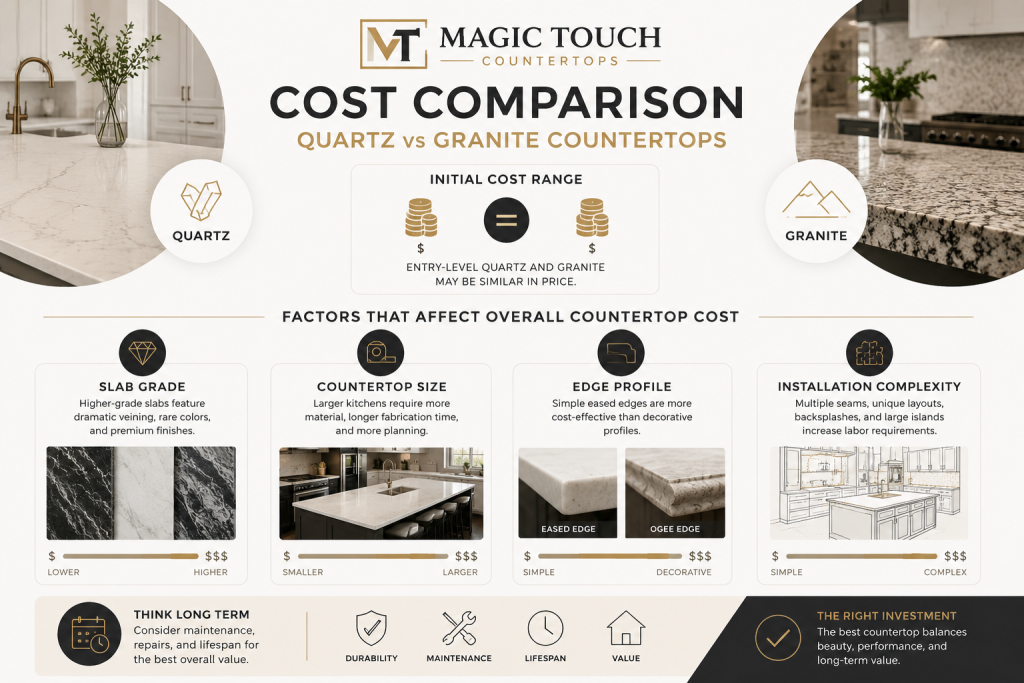
Cost Comparison: Quartz vs Granite Countertops
Price is one of the first factors homeowners evaluate, but material cost alone does not tell the entire story. Several variables influence the final project investment, including slab quality, thickness, edge profile, sink cutouts, backsplash fabrication, installation complexity, transportation, and material availability.
Entry-level granite and quartz products may be similarly priced, while premium selections in either category can vary considerably. Rather than focusing only on the initial purchase price, homeowners should consider long-term costs associated with maintenance, repairs, and expected lifespan.
Factors That Affect Overall Countertop Cost
- Slab grade: Higher-grade slabs often feature more dramatic veining, rare colors, larger uninterrupted patterns, and premium finishes.
- Countertop size: Larger kitchens require more material, longer fabrication time, and more installation planning.
- Edge profile: Simple eased edges are usually more cost-effective than decorative ogee or double ogee profiles.
- Installation complexity: Multiple seams, unusual layouts, integrated backsplashes, and oversized islands can increase labor requirements.
Durability Comparison: Quartz vs Granite Countertops
Both materials are considered premium countertop surfaces and can provide decades of reliable performance when professionally fabricated and properly maintained. However, their strengths differ depending on how the countertop will be used.
Quartz excels in stain resistance and requires very little routine maintenance. Granite offers exceptional resistance to scratches and high temperatures because of its natural stone composition.
1.Scratch Resistance
Quartz is highly resistant to scratches during normal household use. Food preparation, small appliance use, everyday cleaning, and bathroom routines rarely damage the surface. Even so, cutting directly on quartz is not recommended because it may dull kitchen knives and repeated abuse can eventually mark the surface.
Granite is one of the hardest natural stones used for residential countertops. Its mineral composition provides outstanding scratch resistance, making it well suited for busy kitchens where food preparation is frequent. Cutting boards are still recommended to protect both the countertop and kitchen utensils.
2.Heat Resistance
Granite naturally withstands very high temperatures. Hot cookware placed briefly on the surface generally does not cause damage because granite formed under extreme geological heat and pressure.
Quartz is also durable, but its engineered composition includes polymer resins. Excessive direct heat may damage these resins over time. Using trivets or heat pads beneath hot pots and pans is recommended to preserve the countertop’s appearance and structural integrity.
3.Stain Resistance
Quartz is non-porous, so liquids remain on the surface rather than penetrating the material. Coffee, wine, juice, makeup, toothpaste, soap, and cooking oils are generally easy to remove when cleaned within a reasonable time.
Granite naturally contains microscopic pores. When properly sealed, it offers excellent stain resistance. Without periodic sealing, oils, colored liquids, or cosmetic products may penetrate certain granite varieties and create stains that are more difficult to remove.
Quartz vs Granite in Different Areas of the Home
Kitchens
Quartz is commonly selected for kitchens because it combines low maintenance, excellent stain resistance, easy cleaning, and consistent appearance. Granite remains an outstanding option for homeowners who prioritize natural beauty and superior heat resistance.
Bathrooms
Bathrooms expose countertops to humidity, soap, cosmetics, and personal care products. Quartz performs exceptionally well because its non-porous surface resists moisture without sealing. Granite can also perform very well when properly sealed and maintained.
The EPA’s guide to mold and moisture in the home reinforces the importance of controlling water and moisture, which is especially relevant for bathrooms, vanities, sinks, and other high-humidity areas.
Laundry Rooms
Laundry countertops frequently come into contact with detergents, bleach, and cleaning products. Quartz’s resistance to staining and ease of cleaning make it a practical choice in these environments. Granite also performs well but may require additional attention if harsh chemicals remain on the surface for extended periods.
How Choosing Between Quartz and Granite Works in Practice
Selecting the right countertop involves more than comparing material samples. Professional countertop projects typically follow a structured process to ensure the finished installation matches the homeowner’s expectations.
- Identify your priorities: Determine whether low maintenance, natural stone appearance, heat resistance, color consistency, or budget matters most.
- Compare actual slabs or samples: Granite should ideally be selected from the exact slab, while quartz samples usually provide more predictable color matching.
- Schedule professional measurements: Accurate templates account for cabinet dimensions, sink openings, faucet locations, appliance clearances, backsplash requirements, and overhangs.
- Review fabrication details: Fabrication includes cutting the slab, polishing edges, creating sink cutouts, drilling faucet holes, preparing backsplashes, and completing quality checks.
- Complete professional installation: Installers position the countertop, verify alignment, secure the surface, install sinks when required, and finish seams and edges properly.
Reviewing completed installations can help homeowners visualize how each surface performs in real spaces. The countertop project gallery provides useful examples of finished stone surfaces, edge details, and completed interior projects.
Technical and Operational Considerations Before Making Your Decision
Selecting a countertop is also a technical decision. Understanding the characteristics of each material helps prevent costly mistakes later.
1.Porosity and Water Absorption
Quartz’s engineered composition makes it virtually non-porous. Granite’s porosity varies depending on the specific stone, making periodic sealing an important maintenance practice for many varieties.
2.UV Exposure
For indoor kitchens and bathrooms, UV resistance is rarely a major concern. However, homeowners planning outdoor kitchens should understand that some quartz products may discolor with prolonged direct sunlight, while granite generally performs better outdoors.
3.Repairability
Minor chips in granite can often be repaired by experienced stone professionals. Quartz can also be repaired in many situations, although perfectly matching certain colors or patterns may be more challenging depending on the manufacturer.
4.Fabrication Safety and Professional Handling
Countertop fabrication requires specialized equipment, dust controls, and trained professionals. The Occupational Safety and Health Administration’s crystalline silica guidance addresses the risks associated with cutting, grinding, and polishing stone materials, which is why professional fabrication conditions matter.
5.Backsplash and Edge Coordination
Countertops rarely stand alone visually. Edge profiles, wall finishes, sinks, faucets, and backsplash materials should be coordinated before fabrication. Homeowners planning a full surface upgrade can evaluate complementary backsplash options for countertop projects to create a more cohesive kitchen or bathroom design.
Quartz vs Granite Countertops Comparison Table
| Feature | Quartz | Granite |
| Material Type | Engineered stone | Natural stone |
| Appearance | Uniform and consistent | Unique natural patterns |
| Maintenance | Very low | Moderate |
| Sealing Required | No | Yes |
| Stain Resistance | Excellent | Very good when sealed |
| Scratch Resistance | Excellent | Excellent |
| Heat Resistance | Very good | Outstanding |
| Moisture Resistance | Excellent | Very good when sealed |
| Color Consistency | Excellent | Natural variation |
| Best For | Low-maintenance homes | Natural stone enthusiasts |
This comparison provides a quick overview, but the final decision should also consider lifestyle, design preferences, budget, installation quality, and the intended application.
Common Mistakes When Comparing Quartz vs Granite Countertops
1.Choosing Based Only on Initial Cost
Many homeowners compare only the purchase price without considering maintenance expenses, expected lifespan, or long-term value. A lower initial investment may lead to higher maintenance costs over time.
To avoid this, evaluate total cost of ownership, including sealing, repairs, cleaning requirements, and expected durability.
2.Ignoring Daily Lifestyle
A countertop should complement how the space is used. A household that cooks frequently may prioritize heat resistance, while a busy family may prefer a surface that requires very little maintenance.
To avoid this, consider cooking habits, cleaning routines, household size, and maintenance preferences before selecting a material.
3.Overlooking Professional Fabrication
Even premium materials can produce disappointing results if fabrication or installation is performed incorrectly. Poor seam placement, inaccurate sink cutouts, and uneven edges reduce both appearance and performance.
To avoid this, choose an experienced countertop fabricator that uses precise templating, quality fabrication equipment, and professional installation practices.
4.Assuming All Granite Is the Same
Granite varies significantly depending on mineral composition, density, color, and porosity. Some varieties require sealing more frequently than others.
To avoid this, ask about the characteristics of the specific slab you select instead of making assumptions based on granite as a general category.
5.Neglecting Long-Term Maintenance
Maintenance requirements differ between quartz and granite. Ignoring these differences often leads homeowners to choose a surface that does not match their expectations.
To avoid this, understand each material’s care requirements before making a final decision.
Benefits of Choosing the Right Countertop Material
1.Better Long-Term Value
A quality countertop can remain attractive and functional for decades when professionally fabricated and properly maintained. Rather than focusing solely on upfront cost, homeowners benefit from considering durability, maintenance, and expected lifespan.
2.Easier Everyday Maintenance
Quartz offers exceptional convenience because it does not require sealing. Granite, while requiring periodic sealing, remains relatively simple to maintain with appropriate care.
3.Improved Home Value
Kitchen and bathroom renovations consistently rank among the projects homeowners value most. Well-designed countertops made from premium materials contribute to a more attractive interior and may improve overall property appeal for future buyers.
4.Greater Design Flexibility
Both quartz and granite are available in numerous colors, finishes, edge profiles, and slab sizes. Whether the goal is a contemporary kitchen, a traditional bathroom, or a transitional design, both materials can integrate well with cabinetry, flooring, backsplashes, and fixtures.
5.Reliable Everyday Performance
When installed by experienced professionals, quartz and granite both provide dependable performance for daily residential use. Their durability makes them suitable for kitchens, bathrooms, laundry rooms, and other frequently used areas of the home.
Frequently Asked Questions About Quartz vs Granite Countertops
1.Which is better: quartz or granite countertops?
Neither material is universally better. Quartz is generally preferred for homeowners seeking low maintenance and excellent stain resistance, while granite is ideal for those who appreciate natural stone and superior heat resistance.
2.Do quartz countertops last as long as granite?
Yes. Both materials can last for several decades when professionally installed and properly maintained. Longevity depends more on installation quality and routine care than on the material alone.
3.Is granite more expensive than quartz?
Not necessarily. Entry-level granite and quartz can have similar pricing, while premium colors, rare slabs, fabrication complexity, and edge profiles can significantly influence the total project cost for either material.
4.Which countertop requires less maintenance?
Quartz requires less routine maintenance because it does not need periodic sealing. Granite should be sealed according to the recommendations for the specific stone to help maintain stain resistance.
5.Which material is better for kitchens?
Both materials perform exceptionally well in kitchens. Quartz is often selected for ease of maintenance and stain resistance, while granite remains popular for natural appearance and high heat tolerance.
6.Can quartz and granite both be used in bathrooms?
Yes. Both materials are excellent choices for bathroom vanities. Quartz provides superior moisture resistance without sealing, while granite performs very well when properly sealed and maintained.
Choosing the Right Countertop for Your Home
Comparing quartz vs granite countertops is ultimately about selecting the material that best aligns with your home’s design, your daily routine, and your long-term expectations. Quartz offers exceptional consistency, stain resistance, and minimal maintenance, making it an excellent option for homeowners seeking convenience.
Granite provides the distinctive character of natural stone, impressive heat resistance, and timeless appeal that continues to make it one of the most desirable countertop materials available.
The best decision is rarely based on a single factor. Budget, lifestyle, maintenance preferences, room usage, fabrication quality, and installation expertise all contribute to the overall success of a countertop project.
Taking time to compare actual slabs, understand material characteristics, and work with experienced professionals helps ensure a finished countertop that delivers lasting performance, beauty, and value.
Find the Right Countertop Solution for Your Project
Whether you are remodeling a kitchen, updating a bathroom, or building a new home, selecting the right countertop material is an important investment. Magic Touch Countertops offers custom fabrication, expert guidance, precision installation, and a wide selection of quartz, granite, marble, and other premium surfaces to help homeowners achieve the right balance of style, durability, and performance.
If you are ready to compare materials, explore design options, or receive professional recommendations for your space, speak with the Magic Touch Countertops team. The team can help you evaluate your project, select the ideal material, and deliver a finished installation designed to perform beautifully for years to come.