
Choosing between granite or quartz countertops is one of the most important decisions homeowners make during a kitchen or bathroom renovation. Both materials are durable, attractive, and widely used in residential projects, but they perform differently in daily life.
The challenge is that many homeowners compare these surfaces only by appearance. In practice, the right countertop depends on maintenance expectations, stain resistance, heat exposure, slab movement, design consistency, fabrication quality, and how the space will be used every day.
A busy family kitchen, a high-end entertaining area, a bathroom vanity, and a rental property may all require different priorities. That is why the best decision is not simply choosing the most beautiful slab, but selecting the surface that fits the home’s routine.

This guide explains how granite or quartz countertops compare in real conditions, what technical details matter, and how to choose the best surface for your project with more confidence.
Which Is Better: Granite or Quartz Countertops?
Granite or quartz countertops can both be excellent choices, but quartz is usually better for homeowners who want low maintenance, controlled patterns, and strong stain resistance. Granite is often better for those who prefer natural stone variation, stronger heat tolerance, and a one-of-a-kind surface. The best option depends on how much maintenance you are willing to handle, your design goals, and the way your kitchen or bathroom is used every day.
Why Countertop Material Choice Matters Today
Countertops are no longer seen as simple work surfaces. In modern homes, they influence design continuity, resale appeal, cleaning routines, food preparation habits, and the overall feeling of the kitchen or bathroom.
For homeowners planning a remodel, countertop selection also affects the full project experience. A surface needs to work well with cabinets, backsplash materials, flooring, lighting, sink placement, and appliance layout. This is why many homeowners begin by reviewing available granite countertop options, comparing engineered quartz styles, and visiting a showroom before making a final decision.
Quartz continues to be a leading choice because it offers consistency, stain resistance, and easier maintenance. Large manufacturers such as Cambria highlight that their quartz surfaces do not require sealing, polishing, or reconditioning. MSI Q Quartz also emphasizes simple everyday cleaning with warm water, soft sponges, and gentle cleaners.
Granite remains highly relevant because it is natural, durable, and visually unique. Each slab has its own mineral pattern, veining, speckling, and depth. Major natural stone suppliers such as Polycor reinforce the importance of proper natural stone cleaning, sealing, and repair practices to preserve long-term performance.
The growing interest in long-lasting kitchen materials reflects a practical concern: countertop replacement is not a frequent project. Once installed, the surface is expected to perform for years. That makes the choice between granite or quartz countertops a strategic decision rather than a purely aesthetic one.
How the Choice Works in a Real Home Project
The process of choosing between granite and quartz should follow a practical sequence. Homeowners should evaluate more than small showroom samples before making a decision.
1. Define how the space will be used
A countertop in a high-traffic kitchen faces more wear than a guest bathroom vanity. Before choosing granite or quartz countertops, consider:
- How often the kitchen is used for cooking;
- Whether children use the space frequently;
- How often spills happen;
- Whether hot cookware is placed near the countertop;
- How much maintenance the homeowner is willing to perform;
- Whether the design calls for natural variation or visual consistency.
2. Compare the full slab, not only a small sample
Granite is a natural stone. Its appearance depends on the minerals present in the slab, which means movement, veining, and color variation can change across the surface.
Quartz is engineered. It is designed to provide controlled patterns, predictable tones, and consistent slab appearance. This can be helpful when matching islands, backsplashes, vanities, and multiple countertop sections.
3. Review maintenance requirements
Granite usually requires sealing to help reduce staining risk. When properly sealed, granite can be easy to clean with mild soap, water, and stone-safe products. MSI explains that sealed granite should be cleaned with soft cloths, mild soap, water, or neutral pH stone cleaners, while abrasive cleansers and harsh chemicals should be avoided through its granite care recommendations.
Quartz is generally considered low maintenance because it is non-porous and does not usually require sealing. Cosentino, the company behind Silestone, provides specific Silestone maintenance guidance for cleaning engineered stone surfaces, including recommendations for everyday care and product testing.
4. Consider fabrication and installation
The final performance of granite or quartz countertops depends heavily on fabrication and installation. Slab selection, measurements, seam placement, sink cutouts, edge profiles, cabinet leveling, support, and finishing all affect the result.
A high-quality material can still disappoint if installation is poorly planned. Professional countertop fabrication and installation helps avoid visible seams in awkward areas, weak overhangs, uneven surfaces, and poorly finished edges.
5. Match the material to the home’s design
Quartz works well in modern, transitional, and clean-lined spaces because it offers controlled patterns and color consistency. Granite works well in traditional, organic, rustic, luxury, and statement kitchens where natural stone movement is part of the design.
Homeowners who want to test visual combinations before committing to a material can also use a countertop space visualizer to compare surfaces, edges, and design directions.
Technical Factors That Influence Countertop Performance
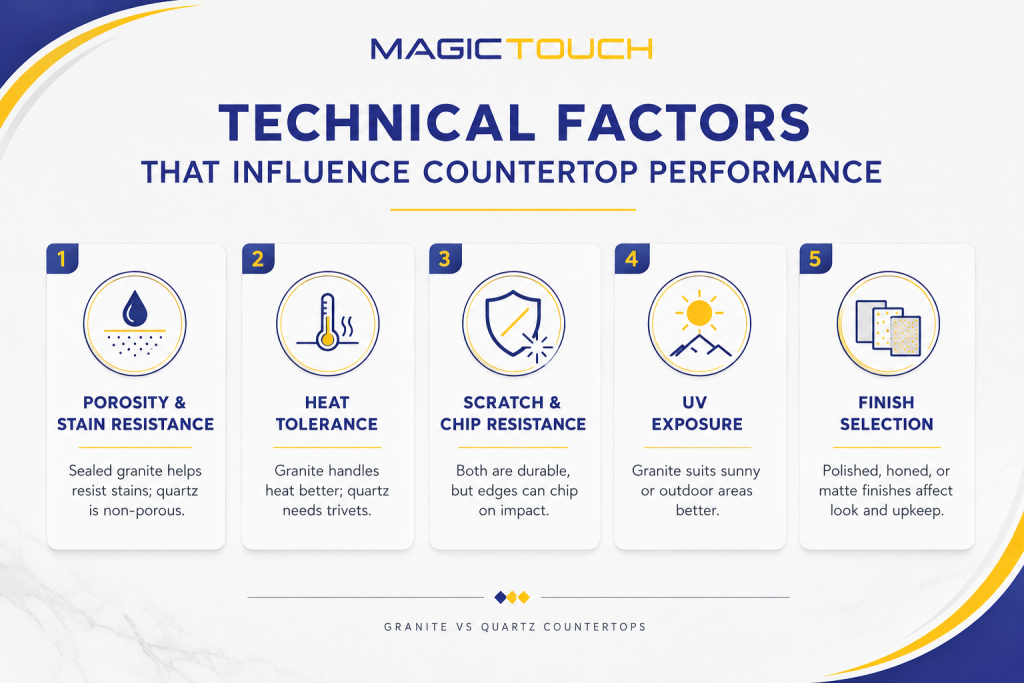
Choosing granite or quartz countertops requires understanding how each material responds to everyday use. The most important technical factors are porosity, heat resistance, scratch resistance, stain resistance, seam planning, thickness, finish, and exposure conditions.
Porosity and stain resistance
Granite is a natural stone, and some slabs are more porous than others. Proper sealing helps reduce the risk of staining from oil, wine, coffee, sauces, and other liquids. However, sealing is not a permanent shield. Spills should still be cleaned quickly.
Quartz is non-porous, which makes it highly resistant to common household stains. This is one reason quartz is popular among homeowners who want a practical surface with fewer maintenance demands.
Heat tolerance
Granite generally handles heat better than quartz because it is a natural stone formed under high geological pressure and temperature. Even so, trivets are still recommended to protect sealers and reduce thermal shock risk.
Quartz is durable, but its resin content can be sensitive to excessive heat. Hot pans, slow cookers, air fryers, and heated appliances should not be placed directly on quartz for extended periods. Trivets and heat pads are the safer option.
Scratch and chip resistance
Both materials are durable, but neither is indestructible. Granite resists scratches well, though sharp impact near edges can cause chips. Quartz also resists scratches in normal use, but cutting directly on the surface is not recommended.
A cutting board should be used with both materials. This protects the countertop finish and preserves the sharpness of kitchen knives.
UV exposure
Granite usually performs better in areas with natural sunlight because its color is part of the stone itself. Quartz may discolor or fade with prolonged direct UV exposure, depending on the product and manufacturer recommendations.
For outdoor kitchens, granite is often the safer choice. Quartz is typically better suited for indoor applications unless the product is specifically rated for exterior use.
Finish selection
Polished finishes remain popular, but honed, matte, and textured finishes are increasingly used in design-forward kitchens. The finish affects both appearance and maintenance. Caesarstone notes that honed, concrete, and rough finishes may require more cleaning than polished finishes because marks and fingerprints can be more visible, according to its quartz surface care guidance.
The right finish should be selected based on the stone type, lighting, cleaning expectations, and design style.
Granite vs Quartz Countertops: Practical Comparison
| Factor | Granite Countertops | Quartz Countertops |
| Material type | Natural stone | Engineered stone |
| Appearance | Unique slab variation | More consistent patterns |
| Maintenance | Usually requires sealing | Does not usually require sealing |
| Stain resistance | Good when properly sealed | Very strong due to non-porous surface |
| Heat resistance | Generally higher | Lower than granite due to resin content |
| Scratch resistance | Strong in normal use | Strong in normal use |
| Outdoor use | Often more suitable | Usually not ideal unless rated for exterior use |
| Design control | Less predictable | Highly predictable |
| Best for | Natural stone character and heat tolerance | Low maintenance and consistent style |
| Main concern | Sealing and stain prevention | Heat exposure and UV sensitivity |
Common Mistakes When Choosing Granite or Quartz Countertops
1. Choosing only by showroom appearance
A small sample does not always show the full slab movement. This is especially important with granite, where color variation and veining can change across the slab. Homeowners should view full slabs whenever possible.
2. Ignoring maintenance expectations
Some homeowners choose granite without considering sealing and cleaning habits. Others choose quartz without understanding heat limitations. The best material is the one that matches daily behavior.
3. Placing hot cookware directly on quartz
Quartz is strong, but direct heat can damage the resin. Trivets should be used consistently, especially near ovens, cooktops, coffee stations, and areas with small heated appliances.
4. Assuming granite never stains
Granite is durable, but it can still absorb liquids if it is not properly sealed. Oil-based stains can be especially difficult to remove. Sealing and quick cleanup remain important.
5. Overlooking seam placement
Poor seam planning can affect both appearance and durability. Professional templating and fabrication help position seams in less visible and structurally appropriate areas.
6. Treating all quartz or granite as equal
Not every slab, brand, or product line performs the same way. Thickness, resin quality, mineral composition, finish, and fabrication standards can all affect the final result of granite or quartz countertops.
Benefits of Choosing the Right Countertop Material
Selecting between granite or quartz countertops correctly can improve both the function and value of a home.
First, the right material reduces daily frustration. A homeowner who wants minimal maintenance may be happier with quartz. A homeowner who cooks frequently with hot pans and values natural variation may prefer granite.
Second, the right countertop improves design consistency. Quartz can create a clean and coordinated look across countertops, islands, backsplashes, and vanities. Granite can create a more organic and distinctive focal point.
Third, proper material selection helps protect the renovation budget. Countertops are a major part of a kitchen or bathroom project, and choosing poorly may lead to avoidable maintenance issues, repairs, or dissatisfaction.
Fourth, both materials can support resale appeal when installed professionally. Buyers often recognize granite and quartz as premium surfaces, especially when the countertop design fits the cabinetry, flooring, lighting, and overall style of the home.
Finally, working with an experienced countertop company helps homeowners avoid common issues related to measurements, fabrication, seams, sink cutouts, edge profiles, and installation support. Reviewing completed premium countertop projects can also help homeowners understand how different materials look in finished spaces.
Frequently Asked Questions About Granite or Quartz Countertops
Is quartz better than granite?
Quartz is better for homeowners who want low maintenance, consistent design, and strong stain resistance. Granite is better for homeowners who prefer natural stone, unique slab movement, and stronger heat tolerance.
Which countertop lasts longer, granite or quartz?
Both granite and quartz can last for many years when installed and maintained correctly. Granite may require periodic sealing, while quartz requires protection from direct heat and prolonged UV exposure.
Do granite countertops need to be sealed?
Many granite countertops benefit from sealing because granite is natural stone and may absorb liquids. The sealing schedule depends on the slab, finish, use intensity, and fabricator recommendations.
Are quartz countertops heat resistant?
Quartz is heat resistant to a degree, but it is not as heat tolerant as granite. Hot pans and heated appliances should not be placed directly on quartz because high heat can damage the resin.
Which is more expensive, granite or quartz?
Pricing varies by slab quality, color, thickness, edge profile, installation complexity, and local availability. Entry-level granite and quartz can be similar, while premium options in either category can cost more.
Which material is better for a busy family kitchen?
Quartz is often preferred for busy family kitchens because it is non-porous and easy to clean. Granite can also work very well, especially when properly sealed and maintained.
Final Takeaway for Homeowners
The choice between granite or quartz countertops should be based on lifestyle, design goals, maintenance expectations, and installation quality.
Quartz is usually the stronger option for homeowners who want a clean look, predictable patterns, stain resistance, and easier maintenance. Granite is often the better fit for homeowners who value natural stone character, stronger heat tolerance, and unique slab movement.
Neither material is automatically better for every home. The most reliable decision comes from comparing full slabs, understanding technical differences, reviewing maintenance needs, and working with experienced countertop professionals.
For kitchens, bathrooms, islands, vanities, and custom stone projects, the best result comes from matching the material to the way the space will actually be used.
Choose the Right Countertop With Magic Touch Countertops
If you are deciding between granite or quartz countertops, Magic Touch Countertops can help you compare materials, review slab options, and plan a surface that fits your home’s design and daily routine.
The company offers granite, marble, and quartz countertop solutions, including fabrication, installation, repair services, and custom countertop projects in Framingham, MA and surrounding areas.
Whether you are remodeling a kitchen, upgrading a bathroom vanity, or planning a custom stone project, working with a specialized countertop team helps ensure accurate measurements, professional fabrication, clean installation, and a polished final result.
Contact a specialist to compare granite, quartz, and marble options for your next home project, or contact the team to request a custom quote.