
Installing a new countertop is one of the most visible upgrades in a kitchen, bathroom, laundry room, or commercial space. While homeowners often focus on installation day, the quality of the finished project depends heavily on everything that happens before the countertop arrives on-site.
Professional countertop fabrication services involve far more than simply cutting a slab of stone. Every measurement, template, machine calibration, edge profile, sink cutout, seam position, and quality inspection influences the final appearance and performance of the countertop.
Whether you choose quartz, granite, marble, quartzite, or porcelain, each material requires specific fabrication techniques and specialized equipment. Modern fabrication combines digital technology with skilled craftsmanship to ensure every countertop fits the space with accuracy and visual consistency.
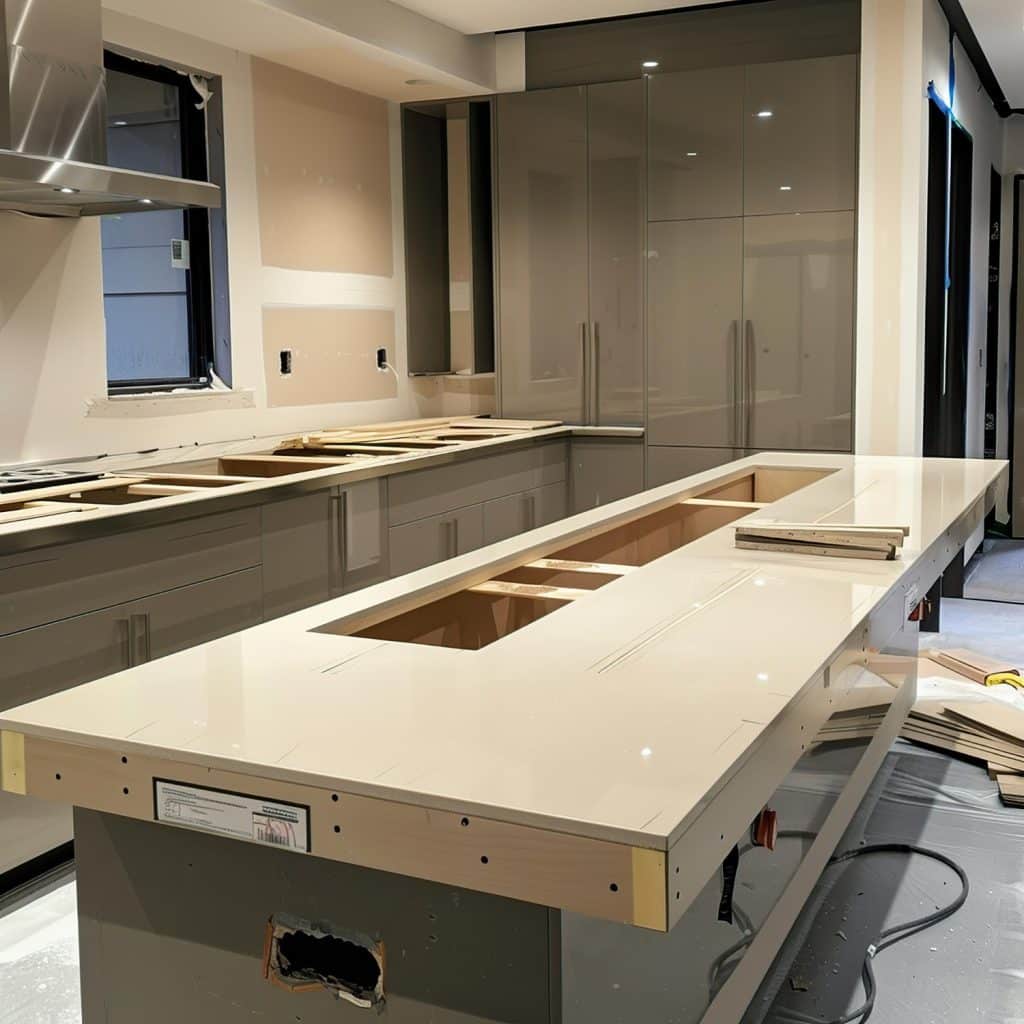
This guide explains what happens before installation, how professional countertop fabrication services work, the technology involved, common mistakes to avoid, and why fabrication quality is just as important as selecting the right countertop material.
What Are Countertop Fabrication Services?
Countertop fabrication services are the professional processes that transform a raw stone slab into a custom countertop ready for installation. The process includes digital measurements, slab inspection, layout planning, precision cutting, edge profiling, sink and faucet cutouts, polishing, quality control, and preparation for transport.
Unlike simple material cutting, fabrication is a customized manufacturing process designed to match the exact dimensions, material characteristics, and design requirements of each project. Proper fabrication ensures accurate fit, structural integrity, visual consistency, and a smoother installation experience.
Why Fabrication Matters Before Installation
Many homeowners assume installation determines the quality of a countertop project. In reality, installation is only the final stage. Most of the technical work has already been completed during fabrication.
Professional countertop fabrication services reduce installation time because every element has already been prepared according to the project’s specifications. Installers primarily position, level, secure, and finish the countertop rather than making major adjustments on-site.
As the countertop industry has evolved, fabrication has become increasingly technology-driven. Digital templating, CNC machinery, bridge saws, and automated polishing systems have improved precision while reducing waste and minimizing avoidable errors.
These advances are particularly important when working with engineered quartz and natural stone materials, where dimensional accuracy directly affects seam quality, edge alignment, sink positioning, and the overall appearance of the finished installation.
The growing demand for premium countertop materials has also increased expectations regarding craftsmanship. The Natural Stone Institute installation standards address technical topics such as seam placement, rodding sink cutouts, overhangs, joint widths, tolerances, and stone finishes, which are all directly connected to fabrication and installation quality.
For homeowners investing in new countertops, fabrication quality often determines whether the final result looks truly custom or simply adequate.
How Professional Countertop Fabrication Services Work
Although every project has unique requirements, professional fabrication generally follows a structured workflow designed to maximize accuracy, protect the material, and support a clean installation.
1. Final Measurements and Digital Templating
Once cabinets are fully installed, leveled, and secured, technicians visit the property to collect precise measurements. This step should not happen too early because cabinet position, appliance placement, and wall conditions directly affect the final countertop dimensions.
Modern fabricators increasingly use laser measuring systems and digital templating equipment instead of traditional cardboard or plywood templates. Digital files provide higher accuracy while allowing fabrication machines to receive exact dimensions electronically.
During this visit, technicians verify:
- Cabinet dimensions
- Wall irregularities
- Appliance clearances
- Sink specifications
- Faucet locations
- Overhang requirements
- Backsplash dimensions
- Seam placement options
Any issue identified during templating can be corrected before fabrication begins, which reduces the risk of gaps, delays, or rework during installation.
2. Material Inspection and Slab Selection
Every slab is carefully inspected before cutting begins. For natural stones such as granite, marble, and quartzite, fabricators evaluate fissures, vein direction, color consistency, surface finish, structural integrity, and thickness variations.
Engineered quartz slabs are also inspected for color consistency, manufacturing defects, transport damage, and finish quality. This is especially relevant for homeowners comparing granite countertop options, marble surfaces, quartz collections, and other stone products before final fabrication.
When multiple slabs are required, fabricators determine the optimal layout to create visual continuity throughout the project.
3. Digital Layout Planning
One of the most overlooked stages of countertop fabrication services is digital slab layout. Using specialized CAD software, technicians position countertop templates directly onto high-resolution slab images.
This planning allows professionals to:
- Optimize material usage
- Preserve natural veining
- Reduce waste
- Minimize visible seams
- Align waterfall edges
- Match bookmatched patterns when applicable
- Improve visual balance
Digital planning is particularly valuable for dramatic quartz, marble, and quartzite designs featuring bold movement or directional veining. Homeowners can also use tools such as the space visualizer for countertop projects to better understand how materials, edges, and finishes may look in a finished space.
4. Precision Cutting
After the digital layout is approved, fabrication begins. Modern fabrication facilities typically use CNC bridge saws capable of producing accurate cuts with minimal tolerance variation.
Unlike manual cutting methods, computer-controlled machinery improves dimensional accuracy, edge straightness, corner precision, repeatability, and material efficiency.
Different countertop materials require different cutting speeds, blade types, cooling methods, and machining parameters to prevent cracking or chipping. The Cosentino technical documentation, for example, provides professional guidance for countertop design, fabrication, installation, and material-specific handling.
5. Edge Profiling
Edge profiles significantly influence both appearance and durability. After cutting, specialized CNC routers shape the countertop edges according to the selected profile.
Popular edge options include:
- Straight edge
- Eased edge
- Beveled edge
- Half bullnose
- Full bullnose
- Ogee
- Mitered edge
- Waterfall edge preparation
Once shaped, the edges undergo multiple polishing stages to achieve a smooth, uniform finish that matches the countertop surface.
Technical Factors That Influence Countertop Fabrication Quality
Not all fabrication shops follow the same standards. The equipment they use, the experience of their technicians, and their quality control procedures all affect the durability, appearance, and installation of the finished countertop.
Professional countertop fabrication services combine advanced manufacturing technology with skilled craftsmanship to produce countertops that meet precise design specifications. Several technical factors determine whether a project will perform well over time.
CNC Machining Improves Precision
Computer Numerical Control machinery has transformed the countertop fabrication industry. Instead of relying only on manual cutting, fabricators use programmed equipment to execute highly accurate cuts, sink openings, faucet holes, and edge profiles.
Benefits of CNC fabrication include:
- Consistent dimensional accuracy
- Reduced material waste
- Cleaner sink cutouts
- Improved seam alignment
- Greater repeatability across multiple pieces
- Better edge uniformity
This level of precision is especially valuable for large kitchen islands, waterfall countertops, and projects requiring multiple slab sections.
Water-Cooled Cutting Protects Stone Integrity
Stone generates significant heat during fabrication. Without proper cooling, excessive temperatures can damage cutting tools and increase the risk of thermal stress within the material.
Professional fabricators use continuous water cooling during cutting operations to reduce dust generation, protect diamond blades, prevent overheating, improve cutting accuracy, and produce cleaner finished edges.
Water-fed equipment also helps control respirable crystalline silica dust. The Occupational Safety and Health Administration identifies respirable crystalline silica as a workplace hazard and provides standards for worker protection in construction, general industry, and maritime environments.
Edge Polishing Requires Multiple Stages
Many homeowners assume polishing occurs in a single step, but professional fabrication involves a progressive polishing sequence. Fabricators gradually move through increasingly finer polishing pads until the edge matches the factory finish of the slab.
Proper polishing improves surface smoothness, gloss consistency, color depth, light reflection, and resistance to staining along exposed edges.
Poor polishing often creates dull spots that become noticeable once the countertop is installed under natural or artificial lighting.
Reinforcements Around Cutouts
Sink openings, cooktop cutouts, and narrow countertop sections create natural stress points. Depending on the material and design, fabricators may install reinforcement rods or structural supports to reduce the likelihood of cracking during transportation or installation.
These reinforcements are commonly used around:
- Undermount sink openings
- Cooktop cutouts
- Dishwasher spans
- Large overhangs
- Narrow bridge sections between openings
Although these supports remain hidden after installation, they contribute significantly to the structural stability of the countertop.
Seam Planning Is Both Technical and Visual
Some projects require more than one slab, making seam placement an important part of fabrication planning. Experienced fabricators position seams where they are less visible, structurally appropriate, easier to align, better supported by cabinetry, and less likely to interrupt prominent veining.
Proper seam preparation includes precise machining, edge polishing, dry fitting, and careful alignment before installation.
For quartz projects, Cambria explains that professionals need to measure the space and account for custom areas before installation, reinforcing the importance of accurate preparation. You can review this guidance on the Cambria quartz countertop installation page.
Quality Control Before Delivery
Before countertops leave the fabrication facility, they typically undergo a comprehensive inspection. Quality control often includes verification of overall dimensions, edge profile consistency, surface finish, sink cutout accuracy, faucet hole placement, corner quality, surface imperfections, color consistency, structural integrity, and labeling of each fabricated piece.
Any issues discovered at this stage can usually be corrected before installation, avoiding delays and additional costs.
Countertop Fabrication Workflow at a Glance
| Fabrication Stage | Primary Objective | Why It Matters |
| Digital templating | Capture precise measurements | Ensures an accurate fit |
| Slab inspection | Evaluate material quality | Identifies defects before cutting |
| Layout planning | Optimize slab usage | Improves aesthetics and reduces waste |
| Precision cutting | Shape countertop components | Produces accurate dimensions |
| Edge profiling | Create the selected edge style | Enhances appearance and durability |
| Cutouts | Prepare sink and faucet openings | Allows smoother installation |
| Polishing | Match the factory surface finish | Improves visual consistency |
| Reinforcement | Strengthen vulnerable areas | Reduces cracking risk |
| Quality inspection | Verify finished components | Prevents installation issues |
| Packaging and transport | Protect fabricated pieces | Minimizes damage before installation |
Common Mistakes During Countertop Fabrication Projects
Even when premium materials are selected, avoidable mistakes during fabrication can negatively affect the final result. Understanding these issues helps homeowners choose experienced professionals who prioritize precision throughout the manufacturing process.
1. Measuring Before Cabinets Are Fully Installed
Fabrication should begin only after cabinets have been permanently installed, leveled, and secured. Measuring too early often leads to inaccurate templates, resulting in gaps, misalignment, or costly rework.
2. Choosing a Fabricator Based Only on Price
Lower prices sometimes reflect limited equipment, fewer quality control procedures, or less experienced technicians. Since fabrication directly affects the appearance and lifespan of a countertop, selecting a qualified fabricator often delivers greater long-term value than choosing the lowest bid.
3. Ignoring Slab Characteristics
Natural stone varies in color, veining, movement, and structural features. Failing to review slab orientation before fabrication may produce mismatched patterns, poorly aligned veins, or visible inconsistencies in the finished installation.
4. Poor Seam Placement
Seams cannot always be avoided, especially on large islands or expansive kitchens. However, poor planning can leave seams highly visible or position them in structurally weak areas, affecting both aesthetics and long-term durability.
5. Selecting Decorative Edges Without Considering Practical Use
Some elaborate edge profiles require additional maintenance and may be more susceptible to chipping in high-traffic kitchens. The most appropriate edge profile should balance style, durability, ease of cleaning, and the intended use of the space.
6. Overlooking Transportation Logistics
Fabricated stone components are heavy, rigid, and difficult to maneuver. Before fabrication begins, professionals evaluate doorway widths, staircases, hallways, elevator access, tight corners, and outdoor access points.
Planning transportation in advance reduces the risk of damage during delivery and installation.
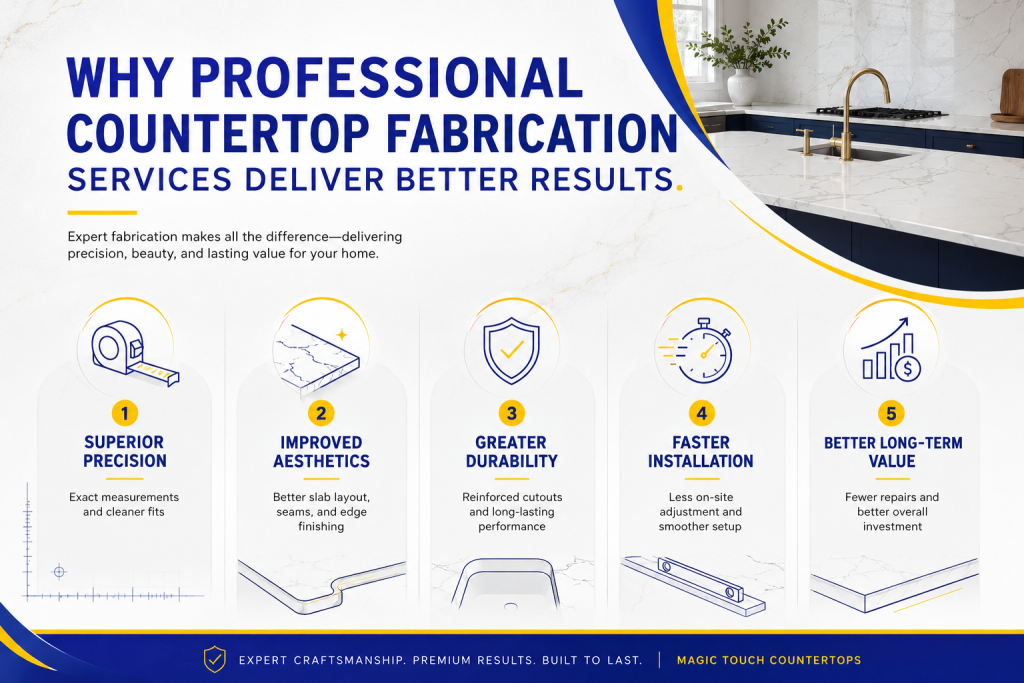
Why Professional Countertop Fabrication Services Deliver Better Results
Investing in professional countertop fabrication services provides advantages that extend beyond installation day. High-quality fabrication influences the countertop’s appearance, structural performance, maintenance requirements, and overall lifespan.
Superior Precision
Advanced digital templating and CNC fabrication allow professionals to manufacture countertops that fit cabinetry with exceptional accuracy. This minimizes gaps, uneven overhangs, and unnecessary adjustments during installation.
Improved Aesthetics
Careful slab planning ensures that natural veining, patterns, and colors flow harmoniously across the countertop. Seam placement, edge profiles, and polished finishes all contribute to a refined, custom appearance that enhances the overall design of the space.
Homeowners who want to review completed surfaces and design styles can explore premium countertop projects before making decisions about material, edge profile, and layout.
Greater Durability
Proper fabrication techniques help reduce stress points that can lead to chips or cracks over time. Reinforced cutouts, accurately machined edges, and professional polishing improve the countertop’s ability to withstand everyday use.
Faster and More Efficient Installation
When fabrication is completed correctly, installers spend less time making adjustments on-site. Accurate dimensions and properly prepared components streamline the installation process and reduce the likelihood of unexpected delays.
Better Long-Term Value
Well-fabricated countertops typically require fewer repairs and maintain their appearance for many years. Homeowners benefit from a finished product that combines durability, functionality, and visual appeal, making the initial investment more worthwhile.
MSI also emphasizes the importance of preparation, inspection, and material handling before quartz fabrication and installation. Their quartz installation guide includes recommendations related to slab acclimation, inspection, and installation preparation.
Frequently Asked Questions About Countertop Fabrication Services
How long do countertop fabrication services usually take?
Most fabrication projects are completed within several business days after the final template is approved. The exact timeline depends on the countertop material, project complexity, custom edge profiles, sink cutouts, and the fabricator’s production schedule.
Can fabrication begin before the cabinets are installed?
No. Cabinets should be permanently installed, leveled, and secured before digital templating takes place. Fabricating countertops before final cabinet installation increases the risk of inaccurate measurements and improper fit.
What is the difference between fabrication and installation?
Fabrication refers to the manufacturing process performed in a specialized workshop. It includes measuring, cutting, polishing, edging, and preparing the countertop. Installation occurs after fabrication and involves transporting the finished countertop to the property, positioning it, securing it, sealing joints when necessary, and completing the final finishing work.
Do all countertop materials require the same fabrication process?
No. Granite, quartz, marble, quartzite, porcelain, and other materials each have unique physical characteristics. Fabrication methods, cutting speeds, tooling, polishing techniques, and reinforcement requirements vary according to the selected material.
Are seams always necessary?
Not always. Smaller countertops can often be fabricated from a single slab. Larger kitchen islands, L-shaped layouts, and extensive countertop designs may require seams due to slab dimensions or transportation limitations.
Can homeowners choose the slab layout before fabrication?
Yes. Many professional fabricators allow clients to review digital slab layouts before cutting begins. This gives homeowners the opportunity to approve vein direction, seam placement, and the overall orientation of the material before fabrication starts.
What to Remember Before Your Countertop Installation
Professional countertop fabrication services are the foundation of a successful countertop installation. Long before the finished surface arrives at the property, a series of carefully planned technical processes ensures that every component is manufactured to precise specifications.
From digital templating and slab selection to CNC machining, edge finishing, reinforcement, and quality inspection, each stage contributes to the countertop’s final appearance, structural performance, and long-term durability.
Understanding what happens before installation allows homeowners to make more informed decisions when selecting both materials and fabrication professionals. While installation is the most visible phase of the project, fabrication is where the craftsmanship, technology, and attention to detail determine the final result.
Choosing an experienced fabricator with modern equipment, proven quality standards, and skilled technicians helps ensure that your investment delivers lasting beauty, functionality, and value.
Ready to Start Your Countertop Project?
Whether you’re renovating a kitchen, upgrading a bathroom, or planning a custom commercial space, working with experienced professionals makes every stage of the project smoother, from material selection to precision fabrication and expert installation.
At Magic Touch Countertops, every project is supported by advanced fabrication technology, premium stone options, and meticulous craftsmanship to create countertops that combine aesthetics with long-term performance. The company works with homeowners, designers, builders, and contractors, offering countertop fabrication, installation, repair, and a showroom with quartz, granite, and marble options.
If you are ready to transform your space with expertly crafted stone surfaces, contact a specialist and request guidance for your next countertop project. The team can help you select the right material, understand the fabrication process, and plan a finished countertop designed to fit your space with precision.